
Tax Edition Episode 39 - Paid money to others? Tell IRS with Information Returns: W-2, 1099-MISC, 1099-NEC & Form 8300
YouTube
(click on the image to watch the video)
Resources
Show Notes
The "Trust But Verify" Guide: 1099-NEC vs. 1099-MISC and Avoiding IRS Penalties
If you have ever stared at a stack of invoices in January, wondering if you need to send a form to your web designer, your landlord, or the local plumber who fixed the office sink, you are not alone.
For small business owners, tax season isn't just about paying what you owe; it's about reporting who you paid. The IRS operates on a system of "Trust but Verify." They don't just take your word for it when you deduct expenses. They use Information Returns to cross-reference the money you pay out against the income other people report.
Failing to file these forms is one of the most common ways to trigger penalties. But don't panic. Whether you are a sole proprietor or managing a growing team, this guide will untangle the alphabet soup of Independent Contractor Tax Forms and help you stay compliant.
The Foundation of Filing: 1099-NEC vs. 1099-MISC
A few years ago, almost everything went on one form: the 1099-MISC. The IRS decided that was too messy and split the team up. Now, we have the "Big Two" forms that every business owner must understand: 1099-NEC and 1099-MISC.
Understanding the difference is the first step in your compliance journey.
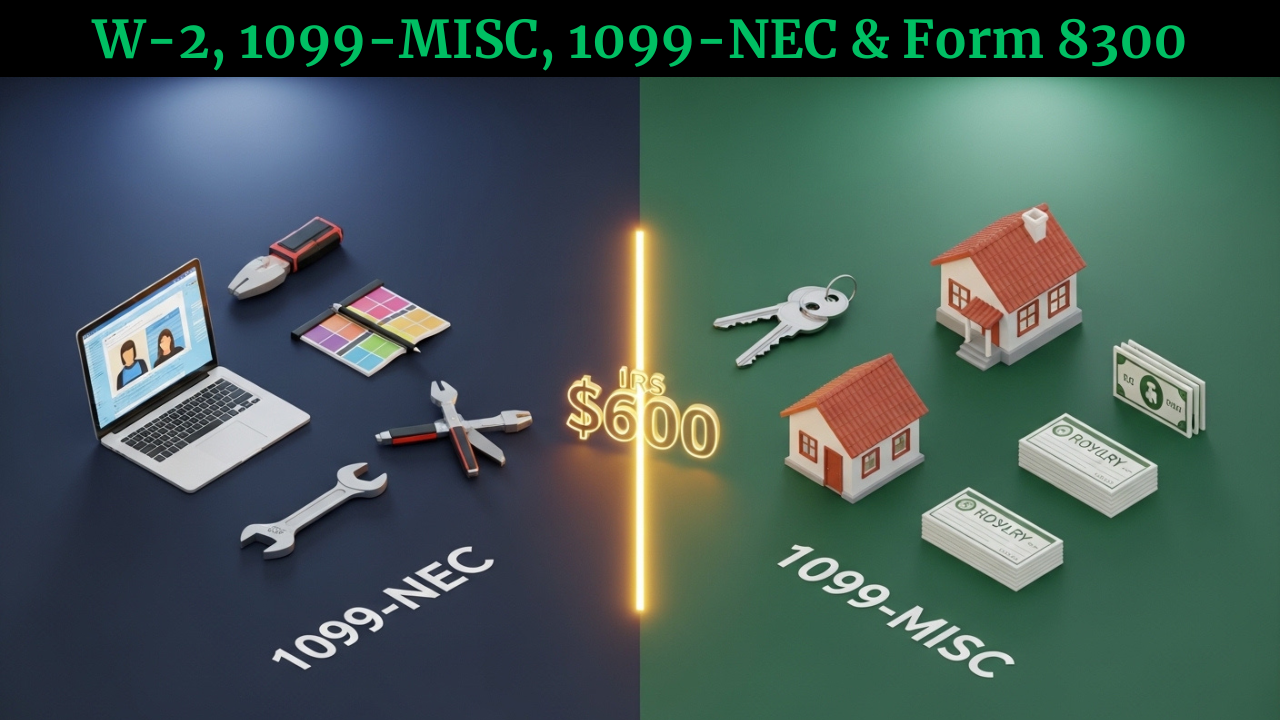
1. IRS Form 1099-NEC: The "Doers"
The "NEC" stands for Nonemployee Compensation. Think of this as the form for the people who actively did something for your business.
- Who gets it? Freelancers, independent contractors, gig workers, and consultants.
- Examples: A graphic designer who made your logo, a lawyer you hired for contract review, or a janitorial service that isn't on your payroll.
- Key Concept: Sweat Equity. If they provided labor or services and aren't your employee, they get the NEC.
2. IRS Form 1099-MISC: The "Passive" Earners
Since the "doers" moved to the NEC form, the 1099-MISC is now primarily for passive payments or specific business transactions.
- Who gets it? Landlords, intellectual property holders, or winners of drawings.
- Examples: Rent payments for office space, royalties for using copyrighted music, or prizes and awards.
- Key Concept: Asset Use. If you are paying to use a physical space or an idea, it generally goes here.
Quick Reference Table: Which Form Do I Use?
| Payment Type | Form Required | Threshold |
|---|---|---|
| Services (Web design, consulting, repair) | 1099-NEC | $600 |
| Rent (Office space, machine rental) | 1099-MISC | $600 |
| Royalties (Intellectual property, oil/gas) | 1099-MISC | $10 |
| Merchandise (Computers, supplies) | None | N/A |
| Personal Payments (Non-business related) | None | N/A |
The $600 Threshold and Its Exceptions
The general "magic number" for reporting is $600. If you paid a vendor $500 over the course of the calendar year, no form is needed. If you paid them $601, you must file.
However, be aware of two critical exceptions:
- Royalties: As noted in the table, the threshold drops to just $10. The IRS wants to know about even small passive income streams.
- Backup Withholding: This is a major "gotcha." If a vendor refuses to give you their Tax ID number and you are forced to withhold tax from their payment to send to the IRS, you must file a 1099-NEC regardless of the amount. Even if it was a $5 payment, if tax was withheld, it must be reported.
Beyond Contractors: W-2s and The "Cash Watchdog"
While 1099s handle your external vendors, you need different tools for your internal team and high-dollar transactions.
Employees vs. Contractors: The Control Test
At what point does a freelancer become an employee? It usually comes down to control.
If you set their hours, provide the equipment (laptops, software), and dictate exactly how the work is done, you are likely not dealing with a contractor anymore. You have an employee.
Do not use a 1099 for an employee.
For employees, you must file Form W-2 (Wage and Tax Statement). Unlike the 1099, which just reports gross pay, the W-2 tells a complex story of wages, tips, and the taxes you withheld (Income Tax, Social Security, Medicare). You are acting as a tax collector for the government, and these forms must be filed with the Social Security Administration.
Form 8300: The Cash Watchdog
Imagine a client pays a $12,000 invoice with a thick envelope of cash. Your first instinct might be relief—no credit card fees! But your second instinct should be compliance.
The IRS monitors large cash flows to prevent money laundering through Form 8300.
- The Rule: You must report any receipt of more than $10,000 in cash in a single transaction (or related transactions) within 15 days.
- What Counts as "Cash"?
- U.S. and foreign currency (coins and bills).
- Crucially: Cashier’s checks, traveler’s checks, and money orders with a face value of $10,000 or less.
Why the expanded definition? A money launderer might not carry a sack of bills, but they might pay you with five $2,500 money orders. To the IRS, that triggers the alarm just as loud as physical cash.
Action Step: Audit your transaction history for the past year. Did you receive any large payments via cash or multiple money orders? If the total hit $10,000, verify if Form 8300 was required.
The Shield and The Sword: W-9 Requirements
Now that you know which forms to file, how do you get the information without chasing people down on New Year's Eve?
The Shield: "No W-9, No Check"
The single best administrative policy you can implement is simple: No W-9, No Check.
Form W-9 is the standard document where a vendor provides their correct name, address, and Taxpayer Identification Number (TIN).
Many business owners wait until January to ask for this. This is a mistake. Vendors may move, change entities, or simply stop responding.
- The Strategy: Treat the W-9 like a ticket to an event. If a vendor wants to enter the "VIP Section" (your bank account), they must show ID (the W-9) first.
- The Risk: If you don't have a TIN, you may be liable for Backup Withholding, where the IRS requires you to withhold 24% of the payment. If you failed to do so, you could be on the hook for that money.
The Sword: Penalties and "Willful Neglect"
The penalties for failing to file Information Returns are indexed to inflation and can accumulate quickly. The IRS judges these penalties based on your intent.
- Reasonable Cause: If you missed a deadline because of a fire, a death in the family, or a serious system failure, the IRS may waive penalties.
- Willful Neglect: If you simply ignored the requirement because you "didn't want to deal with paperwork," penalties skyrocket. Unlike standard fines, penalties for willful neglect often have no maximum limit.
Penalty Mitigation Strategy
We are all human, and typos happen. If you make a "de minimis" error (a small mistake on a name or dollar amount), you generally have until August 1st to correct it without a fine.
However, relying on corrections is stressful. The goal is accuracy from day one.
Interactive Quiz: Do I Need to File?
Struggling to decide if a payment needs a form? Use this simple checklist.
1. Is the payment to a corporation (Inc, Corp)?
- Yes: Generally, no 1099 is needed (Exceptions apply for legal fees).
- No: Proceed to question 2.
2. Was the payment for a physical product (merchandise)?
- Yes: No 1099 needed.
- No: Proceed to question 3.
3. Did you pay them via credit card or third-party network (like Upwork)?
- Yes: The payment processor usually handles the 1099-K.
- No (Paid via check, cash, Venmo/Zelle business, ACH): Proceed to question 4.
4. Did the total payments exceed $600 for the year?
- Yes: FILE A 1099. (Use NEC for services, MISC for rent).
Your Compliance Action Plan
Don't let tax compliance become a crisis. By implementing a few proactive steps, you can build a financial safety net for your business.
- Download Form W-9: Go to the IRS website today and download the latest version.
- Update Onboarding: Integrate the W-9 into your vendor onboarding immediately. Put a link to it in your email signature or keep printed copies on your desk.
- Review Vendor Lists: Open your accounting software. Categorize every person you paid this year. Was it for rent? (1099-MISC). Was it for labor? (1099-NEC).
- Check for Cash: specific "Cash Watchdog" audit for payments over $10,000.
Mastering Information Returns isn't the most glamorous part of entrepreneurship, but it is essential to keeping your business safe, sound, and audit-proof.
Need Help Navigating Your Business Taxes?
If you are feeling overwhelmed by the "Big Two" forms or need assistance setting up your payroll and contractor compliance systems, we are here to help.
Contact Us Today to Secure Your Financial Future
DISCLAIMER: This content is for educational purposes only and should not be considered personalized financial advice. Always consult with a qualified financial professional before making financial decisions.