
Tax Edition Episode 36 - Small Business Taxes 101: Every Tax You Need to Know (Income, SE, & More)
YouTube
(click on the image to watch the video)
Resources
Show Notes
Small Business Taxes for Beginners: A Survival Guide for the DIY Entrepreneur
Close your eyes for a second. Think back to your days as an employee. Remember getting that paycheck? You’d look at the gross amount, then the net amount, and maybe sigh a little at the difference. But honestly? You didn’t have to do anything. Your employer was like a silent financial guardian, withholding your taxes and sending them to the IRS for you.
But now? You’ve traded that security for freedom. You are the boss.
With that title comes a fundamental shift that shocks almost every new entrepreneur: the first tax bill.
If you are reading this, you are likely in the early stages of your business journey. You might be a freelancer, a consultant, or a solopreneur. And if the thought of the IRS keeps you up at night, you aren't alone. The reality is that the IRS operates on a "pay-as-you-go" system. When you’re the owner, there is no one withholding money for you. You have total liability.
If you aren't prepared, April 15th isn't just a deadline; it’s a panic attack.
In this guide, we are going to demystify Small Business Taxes. We will break down the four main "buckets" of tax liability so you can stop worrying about jail time and start focusing on your bottom line.
1. The Foundation: Income Tax and Business Structures
Think of Income Tax as the baseline entry fee for doing business in America. However, the specific form you file depends entirely on what "species" of business you are. This is often where new business owners get stuck, unsure if they are filing correctly.
The "Species" of Business
Let's break down the most common structures and the forms they require:
-
Sole Proprietorship Taxes (The Schedule C Form):
If you haven’t filed any special paperwork to incorporate, this is likely you. You and the business are legally the same entity. You don’t file a separate tax return for the business. Instead, you attach a Schedule C Form to your personal 1040 return. Think of it like wearing a backpack; the business is just extra weight—or profit—carried on your personal back. -
Partnerships (Form 1065):
If you have a co-founder, you generally fall here. Partnerships file Form 1065. The critical concept here is Pass-Through Taxation. Imagine the partnership as a pipeline. The business itself doesn't pay income tax; the money flows through the pipeline directly to the partners' personal tax returns. This structure allows you to avoid "double taxation" because the money is only taxed once—when it hits your hands. -
Corporations (Form 1120 or 1120-S):
- C-Corps (Form 1120): The corporation is a separate legal person that pays its own taxes. If it pays you dividends, you get taxed on that too (Double Taxation).
- S-Corps (Form 1120-S): Many small businesses elect S-Corp status. Like partnerships, these are pass-through entities where profit flows to shareholders, avoiding the double tax hit.
The Great LLC Confusion
"But Alex," you might ask, "I set up an LLC. What about LLC Tax Filing?"
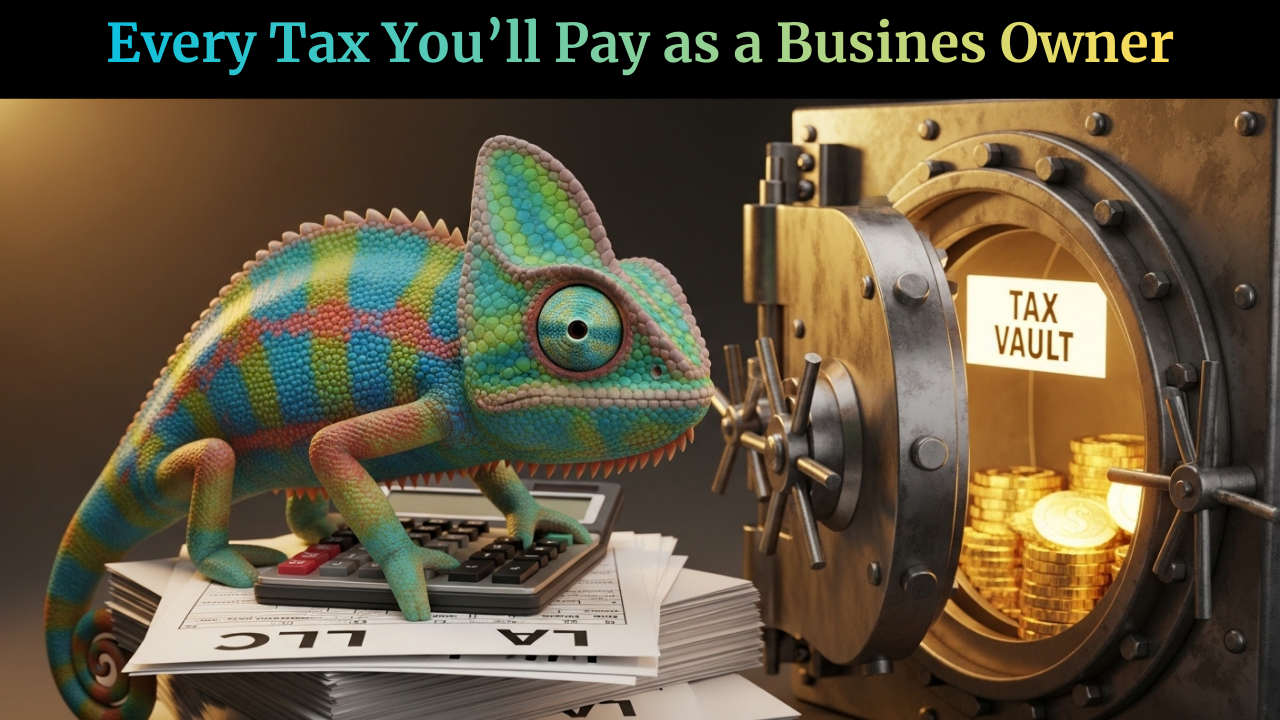
Here is the secret: The IRS doesn't actually have a specific form for an LLC. An Limited Liability Company is like a chameleon. For tax purposes, it has to mimic one of the other structures.
- Single-Member LLC: The IRS treats you as a Sole Proprietor (Schedule C).
- Multi-Member LLC: The IRS treats you as a Partnership (Form 1065).
- Election: You can choose to be treated as a C-Corp or S-Corp.
Action Item: Review your business registration documents today. Confirm your legal structure. Are you a Sole Prop, an LLC, or a Corp? Once you know that, identify the corresponding tax form. Write it down on a sticky note and put it on your monitor. That form number is your roadmap.
2. The Solopreneur's Burden: Understanding Self-Employment Tax
Once you know how to file, we have to talk about the "hidden cost" that trips up almost every new owner. It’s the moment you look at your tax return and think, "Wait, why is this number so high? I thought I made decent money!"
Welcome to Self-Employment Tax.
The "Silent Partner" is Gone
When you were a W-2 employee, you and your employer split the cost of Social Security and Medicare. You paid half, and they paid half. Now that you are the boss, you wear both hats. This means you are responsible for the full 15.3% share.
This tax kicks in the moment your net earnings hit $400 or more.
It is crucial to understand that Self-Employment Tax is separate from Income Tax. You can technically owe zero dollars in income tax because of deductions and still owe Self-Employment tax because you made a profit.
The Silver Lining: The Deduction
There is a little bit of good news. The IRS offers a relief mechanism called the "employer-equivalent" deduction. You can deduct half of your Self-Employment tax from your adjusted gross income on your personal 1040 return. It’s not a dollar-for-dollar credit, but it does lower your taxable income.
Strategic Question: When you set your hourly rate or product pricing, did you factor in that extra 15% off the top? If you're realizing your margins are too thin, it might be time to raise your prices to cover that "employer" portion you are now paying.
3. Pay-As-You-Go: Mastering Quarterly Estimated Taxes
Now that we know what you owe, we need to discuss when you pay it.
There is a massive myth floating around that business owners can wait until April 15th to pay their entire annual liability. Debunk that right now. The US operates on a "pay-as-you-go" system. If you wait until April, even if you have the cash, the IRS will likely hit you with an underpayment penalty.
Who Needs to Pay Quarterly?
You must make Quarterly Estimated Taxes if you expect to owe:
- $1,000 or more (Sole Proprietors, Partners, S-Corp Shareholders)
- $500 or more (Corporations)
The Tool: Form 1040-ES
Form 1040-ES is your quarterly invoice. It helps you calculate your expected income, divide the tax owed by four, and tells you what to send in. These payments are generally due in April, June, September, and January.
Cash Flow Strategy: The Tax Vault
How do you ensure you have the money when these deadlines hit? Stop treating your business checking account balance as "available spending money."
Implement the Tax Vault Strategy:
- Open a separate high-yield savings account.
- Every time a client pays you, immediately transfer 25% to 30% into that vault.
- Do this before you pay bills or pay yourself.
When the quarterly deadline arrives, you simply transfer the money to the IRS. You turn a potential financial crisis into a simple administrative task.
Guiding Question: Are you relying on hope, or do you have a plan? Download Form 1040-ES today and mark the four quarterly payment deadlines on your calendar.
4. Growing Pains: Employment and Excise Taxes
As your business scales, you may find you need help. This brings us to the final two buckets: Employment and Excise taxes.
The Unpaid Tax Collector
When you hire an employee, you stop being just a taxpayer and become a tax collector for the government. You are responsible for handling the "Big Three" Employment Taxes:
- FICA: Withholding the employee's share of Social Security/Medicare and paying your matching share.
- Federal Income Tax: Withholding based on their W-4.
- FUTA: Federal Unemployment Tax (paid entirely by you, not the employee).
The Danger Zone: Independent Contractor vs. Employee
Many new entrepreneurs try to avoid this paperwork by hiring everyone as an "Independent Contractor." Be careful.
The IRS looks at behavioral control to determine classification.
- Contractor: Uses their own equipment, sets their own hours, works for multiple clients (e.g., a web designer you hire for a specific project).
- Employee: You control when, where, and how they work; you provide equipment and training.
If you misclassify an employee as a contractor to avoid payroll taxes, you could be liable for back taxes and heavy penalties.
Excise Taxes: The Niche Bucket
Finally, there are Excise Taxes. These are levies on specific goods or activities, such as:
- Operating heavy trucks (Form 2290)
- Gambling/Wagering
- Indoor Tanning
- Fuel sales
For most digital solopreneurs, this won't apply. But if your business falls into these categories, failing to file Form 720 or 2290 can shut you down fast.
Summary: Seizing Financial Control
We’ve covered the four pillars of small business taxation:
- Income Tax: Filing the right form (Schedule C, 1065, 1120) based on your structure.
- Self-Employment Tax: Budgeting for the 15.3% contribution to your own social safety net.
- Estimated Taxes: Using Form 1040-ES to pay quarterly and avoid penalties.
- Employment/Excise Taxes: Correctly classifying workers and handling niche levies.
The "Annual Surprise" is only a surprise if you aren't paying attention. By understanding which buckets you fall into and setting up a "Tax Vault," you can navigate tax season with confidence rather than fear.
Ready to Get Organized?
Don't let the paperwork bury your business dreams. If you want to ensure you are starting on the right foot, we have resources to help you.
Get our "First Year Business Tax Checklist" and professional guidance today.
👉 Click Here to Contact Safe Simple Sound
Disclaimer: Tax laws change frequently. Always consult with a qualified tax professional regarding your specific business situation.
DISCLAIMER: This content is for educational purposes only and should not be considered personalized financial advice. Always consult with a qualified financial professional before making financial decisions.