
Retirement Planning Edition Episode 8 - Surviving the Descent: Why Retirement Math Changes When You Quit Working
YouTube
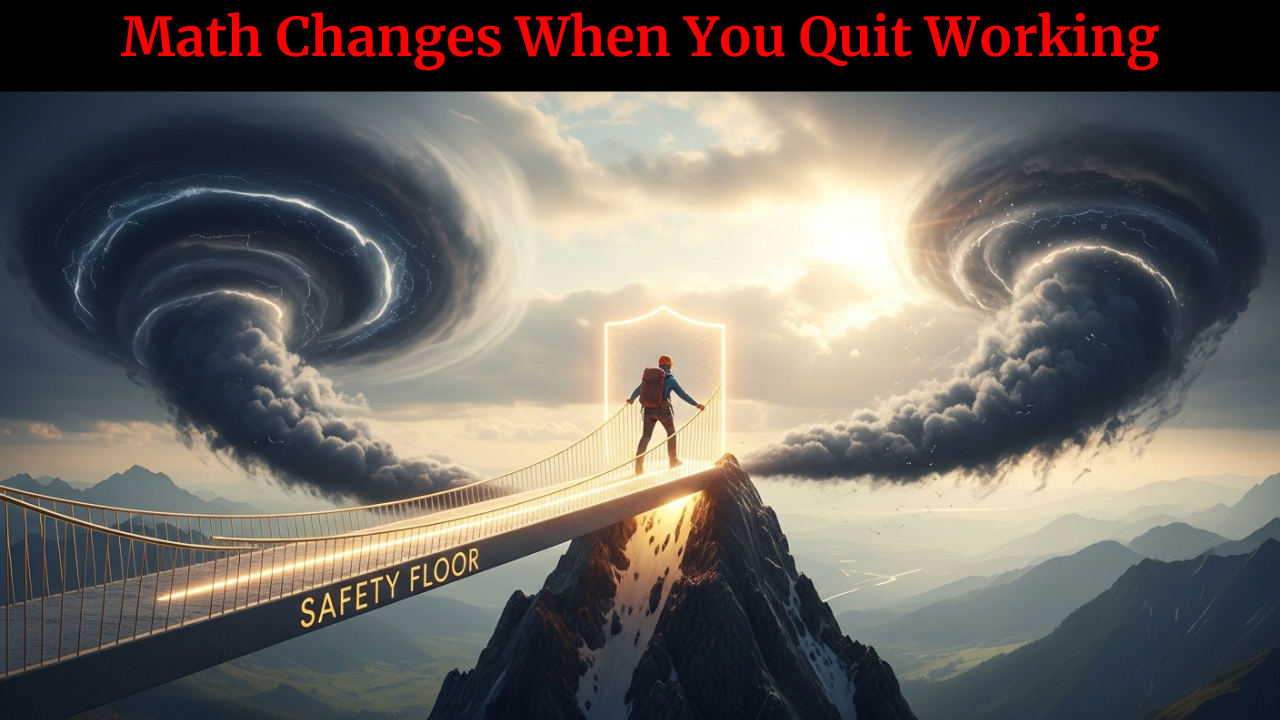
(click on the image to watch the video)
Resources
Show Notes
Surviving the Descent: Why Retirement Math Changes When You Quit Working - Show Notes
Mastering the critical shift from accumulation to distribution using the S3 Safety Floor
Quick Episode Summary
In this pivotal episode, we address the most dangerous phase of the financial lifecycle: the transition from saving money to spending it. Using the "Retirement Distribution Mastery" framework, we explore why the mathematical rules that helped you build wealth can actually hurt you once you start withdrawing income. We dismantle the myth of "average returns" in retirement and introduce the SafeSimpleSound "Safety Floor"—a constitutional strategy that protects your lifestyle from market volatility while ensuring your portfolio grows enough to beat inflation.
SafeSimpleSound Framework Featured
This episode applies the S3 methodology to solve the "Retirement Distribution" dilemma:
- Primary Principle: Both/And Solutions. We reject the false choice between being "Aggressive" (Growth) or "Conservative" (Safety). A constitutional plan integrates both to survive the descent.
- S3 Characteristic Emphasis: Safe (The Floor) and Sound (Growth for Inflation), executed through Simple buckets.
- Contradiction Resolved: The tension between Sequence of Returns Risk (needing safety today) and The Longevity Paradox (needing growth for tomorrow).
Who This Episode Serves
- Pre-Retirees (The "Red Zone"): Individuals 5 years away from retirement who need to audit their portfolio for distribution safety.
- Current Retirees: Those experiencing "Financial Anorexia"—the fear of spending their savings despite having adequate resources.
- Accumulators: Savers who want to understand the long-term destination of their financial mountain climb.
What You'll Learn
- Discover why the "average returns" that served you during accumulation become a dangerous metric during distribution.
- Identify "Sequence of Returns Risk" and how a market drop in early retirement creates a mathematical hole you may never dig out of.
- Construct a "Safety Floor" that covers your essential expenses, giving you the psychological permission to spend without fear.
- Resolve the conflict between inflation risk (losing purchasing power) and market risk (losing principal) using the S3 bucket approach.
- Overcome "Financial Anorexia" by structuring a plan that separates your grocery money from your growth money.
Key Topics & Concepts
Primary Focus: Retirement Distribution Planning & The Decumulation Phase
Concepts Covered:
- The Descent: The distinct financial phase where you stop adding funds and start withdrawing, requiring a shift in strategy.
- Sequence of Returns Risk: The risk that the timing of withdrawals during a market downturn will permanently deplete a portfolio.
- The Longevity Paradox: The challenge of funding a 30-year retirement ("30-year weekend") where inflation erodes purchasing power.
- Safety Floor: An S3 mechanism ensuring essential expenses are covered by reliable income or stable assets, independent of market performance.
- Financial Anorexia: The psychological paralysis and fear of spending wealth that has been accumulated over a lifetime.
Professional Authority Elements:
- Demonstration of Reality-Based Planning over theoretical averages.
- Application of Trustworthy Tortoise pacing to retirement transitions.
- Expertise in Distribution Math distinct from Accumulation Math.
Stakeholder Value Creation:
- For Clients: Provides peace of mind through a structured spending plan.
- For Families: Protects the estate from depletion due to poor market timing.
- For the Community: Educates on the psychological shifts required for a healthy retirement.
Episode Breakdown
Opening: The Summit is Only Halfway
- Metaphor: Comparing financial planning to mountaineering; most accidents happen on the descent (distribution), not the climb (accumulation).
- The Shift: Moving from the "Accumulation Phase" to the "Decumulation Phase."
- Contradiction: The need for growth (to beat inflation) vs. the need for safety (to prevent loss).
Section 1: When Average Math Fails
Insights:
- Accumulation Math: Volatility is a friend when you are buying shares (Dollar Cost Averaging).
- Distribution Math: Volatility is an enemy when you are selling shares to live.
- The River Analogy: Crossing a river that is "4 feet deep on average" is fatal if the middle is 12 feet deep. Relying on average market returns works the same way.
Practical Applications:
- Stop looking at "average" portfolio performance and start looking at "sequence" reliability.
Section 2: The Two Great Risks
Insights:
- Sequence of Returns Risk: A 20% drop combined with a 5% withdrawal creates a compound problem that destroys capital.
- The Longevity Paradox: Living longer means inflation is a major threat. Cash loses purchasing power; stocks have volatility.
- Both/And Solution: You cannot choose either safety or growth. You must integrate them to handle a 30-year timeline.
Section 3: Arthur & Martha Case Study
The Scenario: A couple with $1M portfolio withdrawing $50k/year (5%).
- Timeline A (The Lucky Path): Markets go up early. Portfolio grows despite withdrawals. They feel brilliant.
- Timeline B (The Descent Danger): Markets drop 15% in Year 1, stay flat in Year 2.
- The Cannibalization Effect: In Timeline B, they are forced to sell shares at a loss to pay bills. Even when the market recovers in Year 3, they have dug a permanent hole because they depleted their capital engine.
Section 4: The S3 Solution - The Safety Floor
Process/Framework/Steps:
- Identify Essential Expenses: Calculate costs for housing, food, healthcare (e.g., $40k).
- Secure Income: Cover these basics with Social Security, pensions, or guaranteed income.
- Build the Bridge: If a gap exists, create a "Cash Bucket" or "Bond Ladder" with 3-5 years of expenses.
- Outcome: When the market drops, you spend from the Safety Floor, not the stock portfolio. You give your stocks time to recover.
Closing: Curing Financial Anorexia
- Psychological Shift: A Safety Floor cures the fear of spending.
- Permission: Knowing the next 5 years of "grocery money" are safe allows retirees to invest the rest for growth without anxiety.
- Evolution: Moving from "guessing" to "knowing" your plan can withstand the descent.
Practical Resources
Self-Reflection Questions
- Vision-First Direction: Do you know the specific "number" required to cover your essential survival expenses versus your lifestyle desires?
- Practical Application: If the market dropped 20% the year you retired, would you be forced to sell stocks to pay your electric bill?
- Implementation: Are you suffering from "Financial Anorexia"—denying yourself experiences today because of unstructured fear about tomorrow?
Examples & Scenarios
The Tale of Arthur & Martha (Timeline B Resolution):
- Situation: Market drops 15% in the first year of retirement.
- Challenge: They need $50,000 to live. Selling stocks now locks in losses.
- S3 Solution: They utilize a pre-built Safety Floor (cash/bonds). They draw their income from this stable bucket, leaving their stocks untouched.
- Key Takeaway: By not selling the stocks during the drop, their portfolio fully participates in the Year 3 recovery. The "Safety Floor" acts as a shield against Sequence of Returns Risk.
Implementation Guide
If you want to apply these constitutional insights:
Step 1: Audit your "Essential Expenses" (Housing, Food, Healthcare).
Step 2: Compare essentials against guaranteed income (Social Security/Pension).
Step 3: Establish a "Sequence of Returns Shield"—a liquid buffer covering any gap for 3-5 years.
Step 4: Download the "Sequence of Returns Shield" guide from SafeSimpleSound.com.
Resources & Tools Mentioned
- The Sequence of Returns Shield: A Foundation PDF guide helping you visualize the "Red Zone" of retirement and audit your protection.
- SafeSimpleSound Blog: "Surviving the Descent" post.
Key Quotes & Insights
"The summit is only halfway. Did you know that most accidents on Mount Everest happen on the way down, not the way up? The same is true in financial planning."
"Relying on 'average' market returns in retirement without a safety protocol is like crossing a river based on the average depth."
"We need a 'Vision-First' strategy. We need to build a Safety Floor before we seek upside potential."
"They aren't gambling with their grocery money; they are investing their surplus."
Professional Authority
S3 Methodology Demonstrated
- Safe Foundation: Establishing the "Safety Floor" (cash/bonds) to cover essential needs for 3-5 years.
- Simple Application: Using a bucket strategy (Safe bucket vs. Growth bucket) to clarify where income comes from.
- Sound Strategy: Keeping a portion of the portfolio in growth assets to combat the long-term erosion of inflation (Longevity Paradox).
Competitive Advantages
- Both/And Thinking: Unlike traditional advice that forces a choice between "Aggressive" or "Conservative," S3 integrates both to solve specific retirement risks.
- Psychological Awareness: Addresses "Financial Anorexia," recognizing that math alone doesn't solve the emotional fear of spending principal.
Educational Generosity Evidence
- The host provides the "Sequence of Returns Shield" guide as a complimentary educational gift, empowering listeners to audit their own plans regardless of whether they become clients.
Additional Learning
Related Topics
- Bond Ladders & Cash Buckets: Exploring the mechanics of the Safety Floor.
- Social Security Optimization: Maximizing the "guaranteed income" portion of the floor.
- Inflation Protection: How to safely expose assets to the market for long-term purchasing power.
Development Pathway
- Current Step: Audit your portfolio for Sequence of Returns Risk using the Shield guide.
- Next Step: Define your "Essential" vs. "Discretionary" expenses to size your buckets correctly.
- Advanced Step: Engage in full S3 Planning to automate the refilling of your Safety Floor.
Connect & Continue the Conversation
Connect with SafeSimpleSound
- Website: SafeSimpleSound.com
- Resource: Download "The Sequence of Returns Shield" guide.
- Email: hello@safesimplesound.com
- Social Media: https://www.linkedin.com/in/phanikandula/
Listener Engagement
We'd love to hear about your journey:
- Have you felt the "Financial Anorexia" fear when spending money in retirement?
- Do you know if your current plan has a "Safety Floor" specifically for the first 5 years?
- How does the "Climbing vs. Descending" metaphor change your view of your nest egg?
Professional Services
SafeSimpleSound creates constitutional financial plans that replace anxiety with structure. By applying the S3 framework, we help families build a "Trustworthy Tortoise" plan that secures the foundation first, allowing them to enjoy the descent with confidence and clarity. Whether through our educational resources or direct planning practice, we are committed to helping you keep your retirement Safe, Simple, and Sound.
DISCLAIMER: This content is for educational purposes only and should not be considered personalized financial advice. Always consult with a qualified financial professional before making financial decisions.