
Retirement Planning Edition Episode 10 - Optimizing Retirement with Tax-Smart Sequencing & Dynamic Guardrails
YouTube
(click on the image to watch the video)
Resources
Show Notes
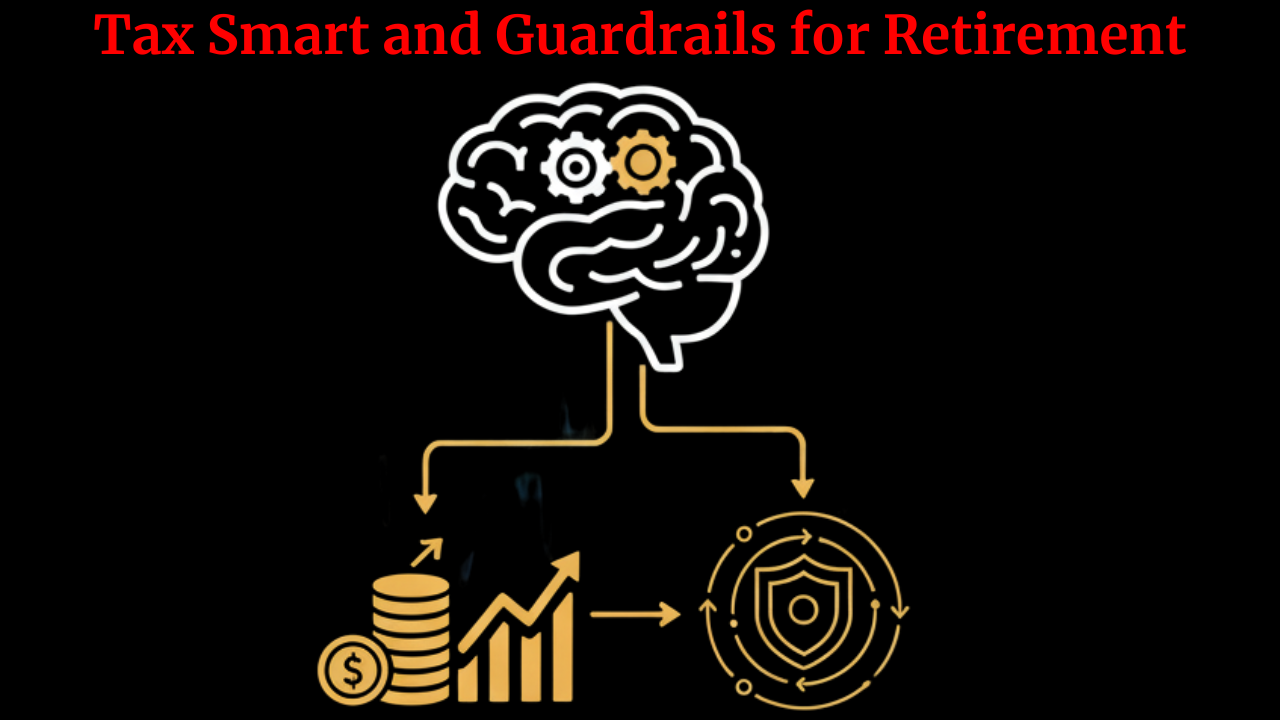
Sound Stewardship: Optimizing Retirement with Tax-Smart Sequencing & Dynamic Guardrails - Show Notes
Achieving Time Coexistence: How to Enjoy Today While Securing Tomorrow
Episode: 3 of 3 (Series Finale)
Quick Episode Summary
In this finale of our three-part series on the architecture of a resilient retirement, we arrive at the "Sound" pillar. We move beyond the foundation of safety and the organization of buckets to explore the engine of optimization. This episode provides a masterclass in "Sound Stewardship," detailing how to transform tax liabilities into strategic levers, reframe Required Minimum Distributions (RMDs), and implement Dynamic Guardrails. We explain how to resolve the tension between current enjoyment and future security through the S3 principle of Time Coexistence.
SafeSimpleSound Framework Featured
- Primary Principle: Time Coexistence — The capability to honor your long-term plan while actively adapting to today's reality.
- S3 Characteristic Emphasis: Sound — moving beyond "safe" preservation to strategic optimization and efficiency.
- Contradiction Resolved: Spending Now vs. Sustainability — We resolve the "Either/Or" dilemma of denying yourself today or running out of money tomorrow by using "Both/And" logic through dynamic adjustments.
Who This Episode Serves
- Retirees Facing Distribution: Individuals approaching age 73 who need to manage RMDs without creating a tax bomb.
- Families in Transition: Pre-retirees (5 years out) or recent retirees (5 years in) looking to move from a static accumulation plan to a dynamic distribution strategy.
- Responsible Spenders: People who struggle with the "permission" to spend their savings because they fear compromising their future security.
What You'll Learn
- Master Tax-Smart Sequencing: How to coordinate withdrawals from Taxable, Tax-Deferred, and Tax-Free silos to control your lifetime tax rate.
- Transform Government Mandates: How to turn RMDs from a nuisance into a systematic refilling mechanism for your spending buckets.
- Implement Dynamic Guardrails: Learn the specific "Capital Freeze" and "Prosperity Rule" protocols that replace the static "4% Rule."
- Apply Qualified Charitable Distributions (QCDs): How to satisfy tax requirements and support causes you care about without increasing your taxable income.
- Automate Financial Peace: How to remove emotional decision-making from market volatility through pre-set decision rules.
Key Topics & Concepts
Primary Focus: Sound Stewardship — The optimization of wealth through tax efficiency and dynamic distribution rules.
Concepts Covered:
- Time Coexistence: The S3 state where current spending and future longevity work in harmony rather than opposition.
- Tax-Smart Sequencing: The strategic order of withdrawals to "fill up" lower tax brackets without spilling over into higher ones.
- The Three Tax Silos:
- Taxable: Brokerage/Savings (Capital gains tax).
- Tax-Deferred: IRAs/401ks (Ordinary income tax).
- Tax-Free: Roth accounts (No tax on distribution).
- Dynamic Guardrails (Guyton-Klinger): A decision-making framework that adjusts spending based on portfolio performance rather than inflation alone.
- Qualified Charitable Distributions (QCDs): A method to transfer IRA funds directly to charity to satisfy RMDs without generating taxable income.
Professional Authority Elements:
- Application of Guyton-Klinger research regarding withdrawal rates.
- Advanced knowledge of tax bracket management and legislative rules (RMD ages).
- Systemization of prudence: Turning complex financial concepts into executable rules.
Stakeholder Value Creation:
- Clients: Gain "permission structures" to spend with confidence.
- Community: Learn to support charities efficiently through QCDs.
- Government/Society: Compliance with tax codes while maximizing personal sovereignty.
Episode Breakdown
Opening: Foundation - The Third Pillar
- Recap: Building on the "Safe" foundation (psychology) and "Simple" buckets (timeline).
- The Tension: Addressing the fear that spending today steals from the future self.
- Establishment: Introduction of "Sound Stewardship" as the engine tuning phase of the S3 framework.
Section 1: Tax-Smart Sequencing
Insights:
- The Instinct Trap: Retirees naturally want to spend "safe" cash first to delay paying taxes, but this often leads to higher taxes later (the "tax torpedo").
- The Silo Strategy: Recognizing that money lives in three distinct tax environments (Taxable, Deferred, Tax-Free).
- Bracket Management: The goal is not to pay zero tax today, but to pay the lowest average rate over a lifetime.
Both/And Solutions Demonstrated:
- We balance Tax Deferral AND Tax Bracket Management by voluntarily realizing some income now to prevent excessive taxation later.
Practical Applications:
- "Fill up" the 12% tax bracket annually using IRA withdrawals, then switch to Roth or Taxable accounts for remaining needs.
Section 2: Turning Rules into Tools (RMDs)
Insights:
- RMDs are not just government demands; they are a forced liquidity event.
- Strategic Refill: Use RMDs to naturally refill "Bucket 1" (immediate spending cash) for the next 12-24 months.
- Generosity & Efficiency: Utilization of QCDs to lower Medicare premiums and support charities.
Process/Framework/Steps:
- Calculate: Determine the RMD amount.
- Assess: Do you need the income for living expenses?
- Direct: If yes, move to spending bucket. If no, direct to charity (QCD) or reinvest in a tax-efficient vehicle.
Section 3: The Dynamic Guardrails
Insights:
- The 4% Rule Flaw: Static withdrawals are like cruise control on a curvy road; they don't account for market reality.
- The Solution: A system that answers "Can I afford a raise?" or "Do I need to tighten my belt?" based on math, not emotion.
The Decision Rules:
- Capital Freeze Rule (Bad Markets): Markets are down -> Keep withdrawal same, but skip the inflation adjustment. Result: Portfolio heals.
- Prosperity Rule (Good Markets): Portfolio grows significantly -> Increase spending permanently. Result: Enjoy the harvest.
Closing: Evolution - Peace Through Process
- Synthesis: Sound planning integrates Tax Efficiency, RMD management, and Guardrails.
- The S3 Promise: Moving from a "guessing game" to a "managed descent."
- Evolution: A financial plan is a living process (a movie), not a static document (a photograph).
Practical Resources
Self-Reflection Questions
- Vision-First Direction: When you spend money on a major trip today, do you feel excitement or guilt? Does your current plan give you "permission" to enjoy it?
- Practical Application: Are you spending your "cash on hand" simply because it is easy, or do you have a strategy for which account you touch first?
- Stakeholder Synthesis: If you do not need your RMDs for daily living, is there a cause or charity you could support using pre-tax dollars via a QCD?
Examples & Scenarios
The Millers (Hypothetical Case Study):
- Situation: A couple, age 68, $1.5M portfolio, withdrawing $60k/year.
- Challenge:
- Scenario A: Recession hits, portfolio drops 15%.
- Scenario B: Bull market, portfolio grows significantly.
- Solution:
- Freeze: Instead of selling out of fear, they simply freeze their inflation adjustment for one year.
- Raise: The system triggers a "Prosperity Rule," granting them a permanent 10% spending increase.
- Key Takeaway: Volatility is not a disaster to be feared; it is a signal to be managed. Small adjustments today prevent catastrophic failures tomorrow.
Implementation Guide
To apply Sound Stewardship to your distribution:
Step 1: Identify Your Silos. Categorize your assets into Taxable, Tax-Deferred, and Tax-Free.
Step 2: Map Your Brackets. Work with a CPA or planner to determine how much IRA money you can withdraw before hitting the next tax bracket jump (e.g., 12% to 22%).
Step 3: Set Your Guardrails. Define the specific portfolio values that will trigger a "spending freeze" or a "spending raise" so you aren't guessing during market swings.
Resources & Tools Mentioned
- "The Dynamic Distribution Guardrails Guide": A Strategy PDF outlining decision rules for freezes and raises.
- S3 Mountain Descent Master Map: A single-page synthesis of the Safe, Simple, and Sound strategies.
- Blog Post: "Sound Stewardship" at SafeSimpleSound.com (includes visual aids).
Key Quotes & Insights
"We have built the engine, but now we must tune it to run efficiently for a thirty-year journey."
"Safety isn't the absence of volatility; the market will always be volatile. Safety is the presence of a plan that handles volatility."
"This is the tension... 'If I spend this money on a trip to Europe today, am I stealing from my eighty-year-old self?'"
"A financial plan is not a document; it is a process. It is a movie, not a photograph."
Professional Authority
S3 Methodology Demonstrated
- Safe Foundation: The Guardrails provide a safety net that prevents running out of money by making small, micro-corrections rather than drastic changes.
- Simple Application: Reframing complex tax codes into a simple "Bucket Refill" maintenance routine via RMDs.
- Sound Strategy: Tax-Smart Sequencing ensures the portfolio lasts longer not by taking more risk, but by being smarter about the rules of the game.
Competitive Advantages
- Adaptability: Unlike static brokerage models that just "sell whatever is available," S3 uses a dynamic, responsive system.
- Holistic Tax View: Viewing taxes as a lifetime bill to be managed, not just an annual bill to be minimized.
- Permission to Spend: Providing psychological comfort through mathematical verification, allowing clients to enjoy wealth without guilt.
Educational Generosity Evidence
- The episode provides the specific logic behind Guyton-Klinger guardrails and QCDs without hiding the "secret sauce."
- Listeners are given enough detail to understand why their current strategy might be flawed (e.g., spending cash first) and how to correct it.
Additional Learning
Related Topics
- Sequence of Returns Risk: Understanding why market drops early in retirement matter more (covered in the "Safe" episode).
- Roth Conversions: A related "Sound" strategy for moving money from Tax-Deferred to Tax-Free silos during low-income years.
- Legacy Planning: How managing taxes today impacts the net inheritance left to beneficiaries.
Development Pathway
- Next Step: Download the "Dynamic Distribution Guardrails Guide" to see the specific math used for decision rules.
- Advanced Application: Explore how "Capital Freezes" interact with the "Cash Bucket" strategy discussed in Part 2.
Further Reading/Learning
- Blog: "Sound Stewardship" on SafeSimpleSound.com for visual charts on tax brackets.
- Research: Search for "Guyton-Klinger withdrawal rules" for deep-dive technical papers on dynamic spending.
Connect & Continue the Conversation
Connect with SafeSimpleSound
- Website: www.SafeSimpleSound.com
- Services: Comprehensive Financial Planning, Investment Management, Retirement Distribution Strategy.
- Email: hello@safesimplesound.com
- Social Media: https://www.linkedin.com/in/phanikandula/
Listener Engagement
We'd love to hear about your journey:
- Do you have a "governor" on your spending, or are you flying blind?
- Have RMDs been a source of frustration for you, and how does viewing them as a "refill tool" change your perspective?
- Which tax silo (Taxable, Deferred, or Free) are you currently relying on most heavily?
Professional Services
SafeSimpleSound is a specialized financial practice dedicated to the S3 Framework. We move beyond commodity investment products to provide a process for the retirement descent. If you want a co-pilot to help set up your Dynamic Guardrails and manage your tax sequencing, we invite you to explore a partnership with us.
Disclaimer: SafeSimpleSound provides educational content and is not a substitute for personalized financial advice. All examples, including the Millers, are hypothetical and for illustrative purposes only. Please consult your tax and financial professionals regarding your specific situation.
DISCLAIMER: This content is for educational purposes only and should not be considered personalized financial advice. Always consult with a qualified financial professional before making financial decisions.