
College Planning Edition Episode 12 - Decoding the Hidden Playbook: The Truth Behind College Financial Aid
YouTube
(click on the image to watch the video)
Show Notes
Decoding the Hidden Playbook: The Truth Behind College Financial Aid - Show Notes
Moving Beyond the "Sticker Price" to Uncover Systematic Enrollment Strategies
Quick Episode Summary
This episode pulls back the curtain on "Strategic Enrollment Management" (SEM), a sophisticated business model used by colleges to protect their bottom line. We decode how schools use data to predict your "willingness to pay" and explore the "Dark Arts" of financial aid, from gapping to front loading, so you can negotiate with constitutional confidence.
SafeSimpleSound Framework Featured
- Primary Constitutional Principle: Both/And Solutions—We resolve the dilemma of finding the "dream school" versus maintaining financial stability by using data to find the right price for your specific profile.
- S3 Characteristic Emphasis: Safe Foundation—Prioritizing long-term security by exposing tactics like "front loading" that can jeopardize a student's ability to finish their degree without excessive debt.
- Contradiction Resolved: The False Choice of Control—Transforming the choice between "DIY stress" or "Blind Trust" into Diagnostic Clarity using the Common Data Set.
Who This Episode Serves
- Analytical High-Earners: Professionals who want to "debug" the college pricing matrix like a software problem.
- Young Families: Parents wanting to build a foundation-first bridge toward education years in advance.
- Strategic Planners: Anyone dealing with the contradiction between a college's marketing "fluff" and their actual financial aid data.
What You'll Learn
- Diagnose the "Dark Arts"—Identify if an award letter is using "gapping" to offer admission in name only.
- Master the Common Data Set (CDS)—Learn how to find the "Rosetta Stone" of college data to see exactly how much merit aid goes to wealthy students.
- Distinguish "Buyers" from "Sellers"—Identify which schools have the highest leverage for negotiation based on their market position.
- Navigate the Rulebook Contradiction—Understand how FAFSA and CSS Profile schools treat your assets differently, especially home equity and small businesses.
Key Topics & Concepts
Primary Constitutional Focus: Sound Strategy—Applying a logical, diagnostic methodology to college selection rather than emotional guessing.
Constitutional Concepts Covered:
- Strategic Enrollment Management (SEM): The merging of admissions and financial aid to maximize university revenue.
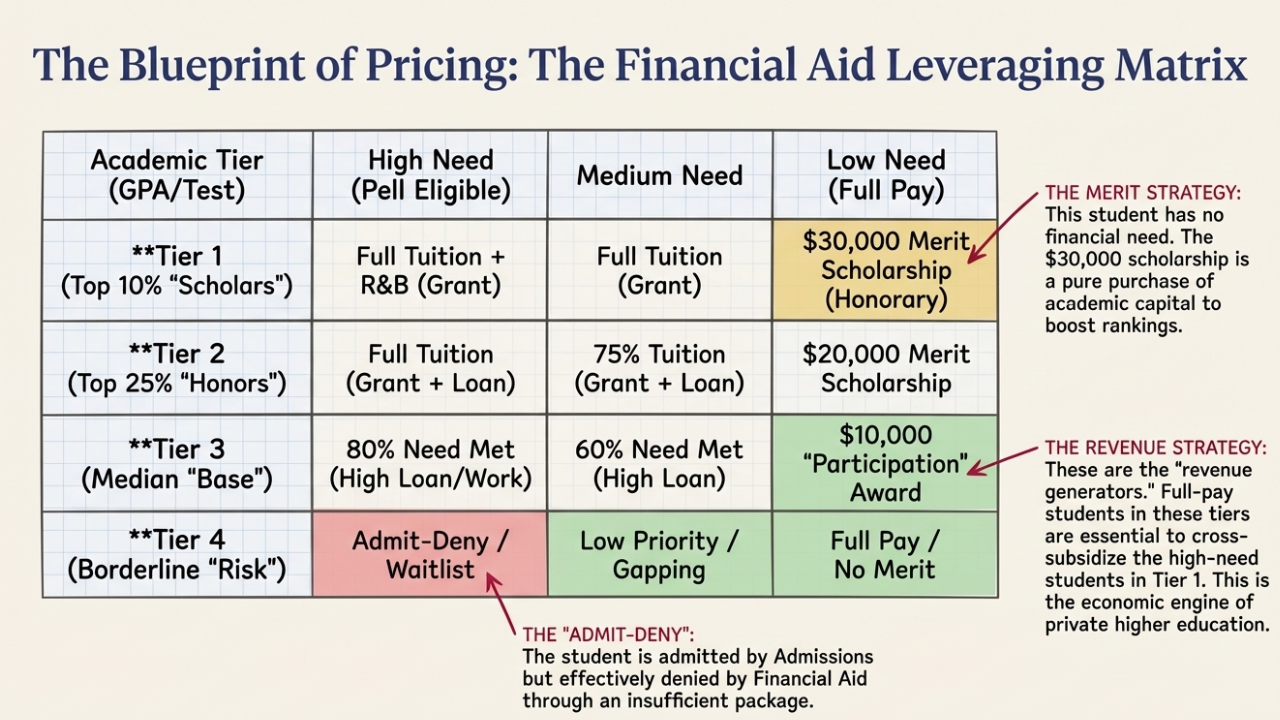
- The Financial Aid Leveraging Matrix: An internal playbook that predetermines aid based on academic profile and perceived need.
- Price vs. Discount: Recognizing that scholarships are often precisely calculated discounts designed to get a "yes" at the highest possible price point.
Stakeholder Value Creation:
- Readers: Standalone clarity on how to read a "Common Data Set" document.
- Prospects: A systematic framework for evaluating college costs as part of a broader financial blueprint.
Episode Breakdown
Opening: The "Sticker Price" Illusion
- The gap between a website's "sticker price" and the precisely calculated real price for your family.
- The transition of financial aid from a question of "need" to a prediction of "willingness to pay".
The "Dark Arts" of Financial Aid
- Admit Deny & Gapping: Sending a congratulations letter with an impossible price tag.
- Front Loading: The bait-and-switch of high freshman grants that shrink in later years.
- Confusing Award Letters: Mixing debt and gifts under the generic heading of "awards".
Decoding the Data
- The Common Data Set (CDS): How to go straight to Section H to find the percentage of students whose full need is actually met.
- Buyers vs. Sellers: Why elite "Sellers" rarely offer merit aid, while "Buyers" use it to hit revenue targets.
Practical Resources
Self-Reflection Questions
- Is the "award" I received a genuine merit-based gift, or is the college "buying" my stats to boost their rankings?
- Does my current financial foundation allow me to handle "front loading" if my grant aid shrinks after year one?
- Based on Section H of the CDS, does this school have a track record of "gapping" families like mine?
Examples & Scenarios
The "Buyer" Negotiation:
- Situation: A student receives an offer from a private college with a high discount rate.
- Challenge: The family knows the school is a "Buyer" but the initial offer is still too high.
- Solution: Using Common Data Set data to prove the school frequently offers merit aid to high-stats students to secure a "yes".
Implementation Guide (Your Secret Weapon)
Step 1: Google "[College Name] Common Data Set" and find the most recent PDF.
Step 2: Go to Line H2H to see the percentage of students who had their full need met—if it's low, expect a gap.
Step 3: Compare Line H2K (grants) to Line H2M (loans) to determine if the aid is "good money" or "bad money".
Key Quotes & Insights
"That scholarship or grant you receive, it's not just a reward for having great grades. It's a discount... designed to be just attractive enough to get you to say yes, without the college giving away a single dollar more than it has to."
"The goal is simple: Make a bad deal look like a good one."
Connect & Continue the Conversation
- Website: www.SafeSimpleSound.com
- LinkedIn: Connect with Phani Kandula
- Strategy: Build your education bridge with our SafeSimpleSound methodology.
DISCLAIMER: This content is for educational purposes only and should not be considered personalized financial advice. Always consult with a qualified financial professional before making financial decisions.